Audio Detection Assistant for Google Maps
Ensuring equal access to audio-based contextual cues
If you're not interested in my process, feel free to shift to sections below
Timeline
Aug - Dec 2024
Tools
Figma
Notion
MS One Drive
FigJam
Team
Timothy Chiu
Disha Sikaria
Rachit Bhayana
Natalie Jarrett
Skills
Accessibility Design
Interaction Design
User Research
WCAG 2.1
Showcase of Interaction on iPhone ScreenInterface on iPhone Showcase
OVERVIEW
The Audio Detection Assistant is a feature designed for the Google Maps platform to enhance the travel experience for Deaf and Hard of Hearing (DHH) individuals by providing contextual awareness of critical audio cues during transportation journeys.
As a member of a team of four, I was responsible for the creation of design assets and components in addition to research responsibilities including, but not limited to conducting background research and usability evaluations.
SCOPE
Deaf or Hard of Hearing (DHH) individuals often encounter barriers to fully engage with their surroundings
The mission was to promote inclusivity and equity by raising awareness of the role auditory information plays in shaping accessible spaces.
UNDERSTANDING
The DHH community had no control nor voice in what was being delivered....
Literature Review
They emphasized the importance of visual cues and improved emergency notifications for enhancing accessibility.
Hearing from the DHH community
We conducted 8 semi-structured interviews with diverse participants, including members of or those familiar with the DHH community.
These interviews with experts highlighted systemic failures in accommodating needs for DHH users as systems were made.
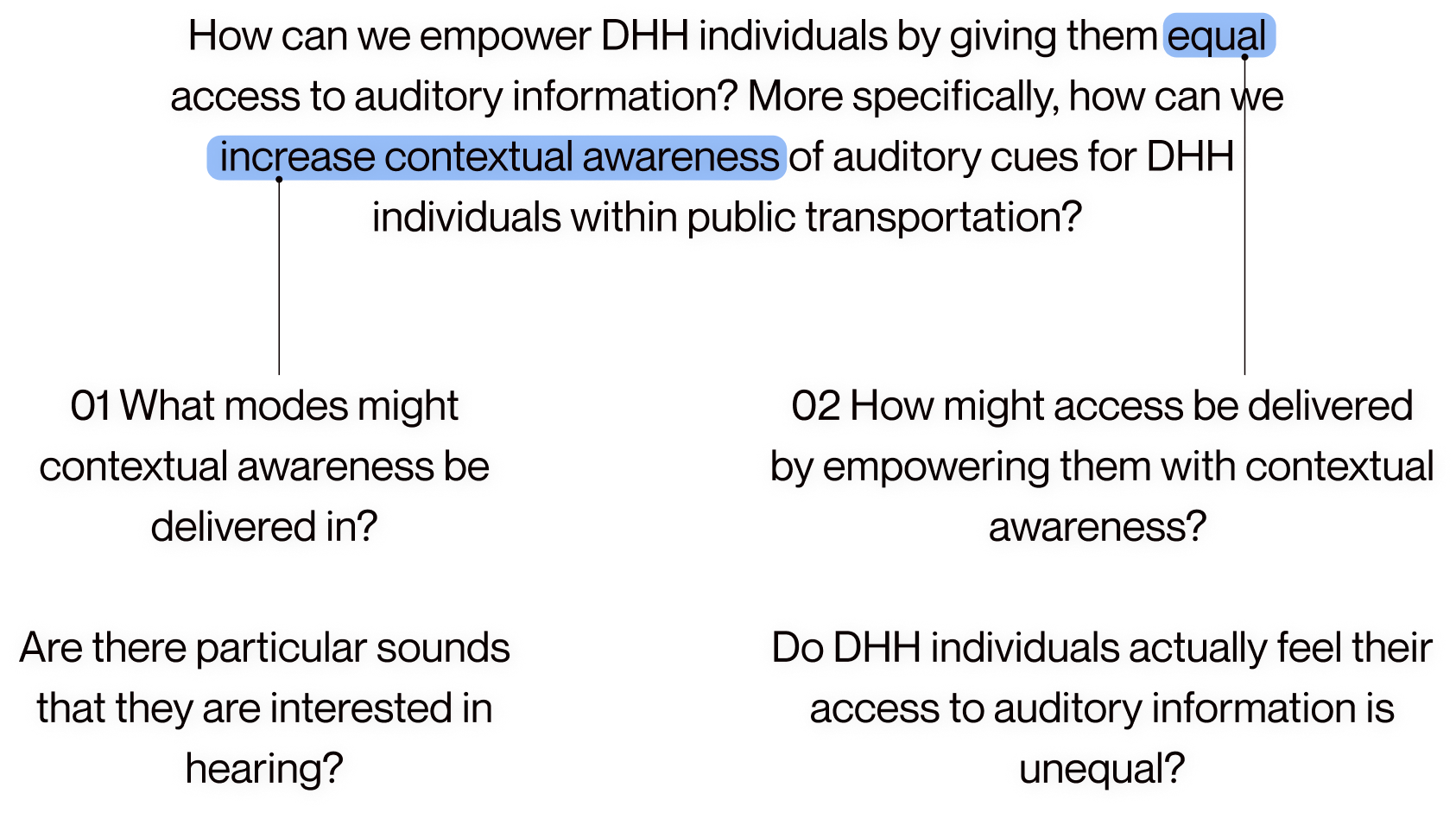
This led to the problem statement that would inform the rest of the design research process...
How can we empower DHH individuals by giving them equal access to auditory information? More specifically, how can we increase contextual awareness of auditory cues for DHH individuals within public transportation? 1. 01 What modes might contextual awareness be delivered in?  Are there particular sounds that they are interested in hearing? 2. 02 How might access be delivered by empowering them with contextual awareness?   Do DHH individuals actually feel their access to auditory information is unequal?
These methods gave insight to the frustrations that DHH users face which ultimately comes down to...
EXPLORATION
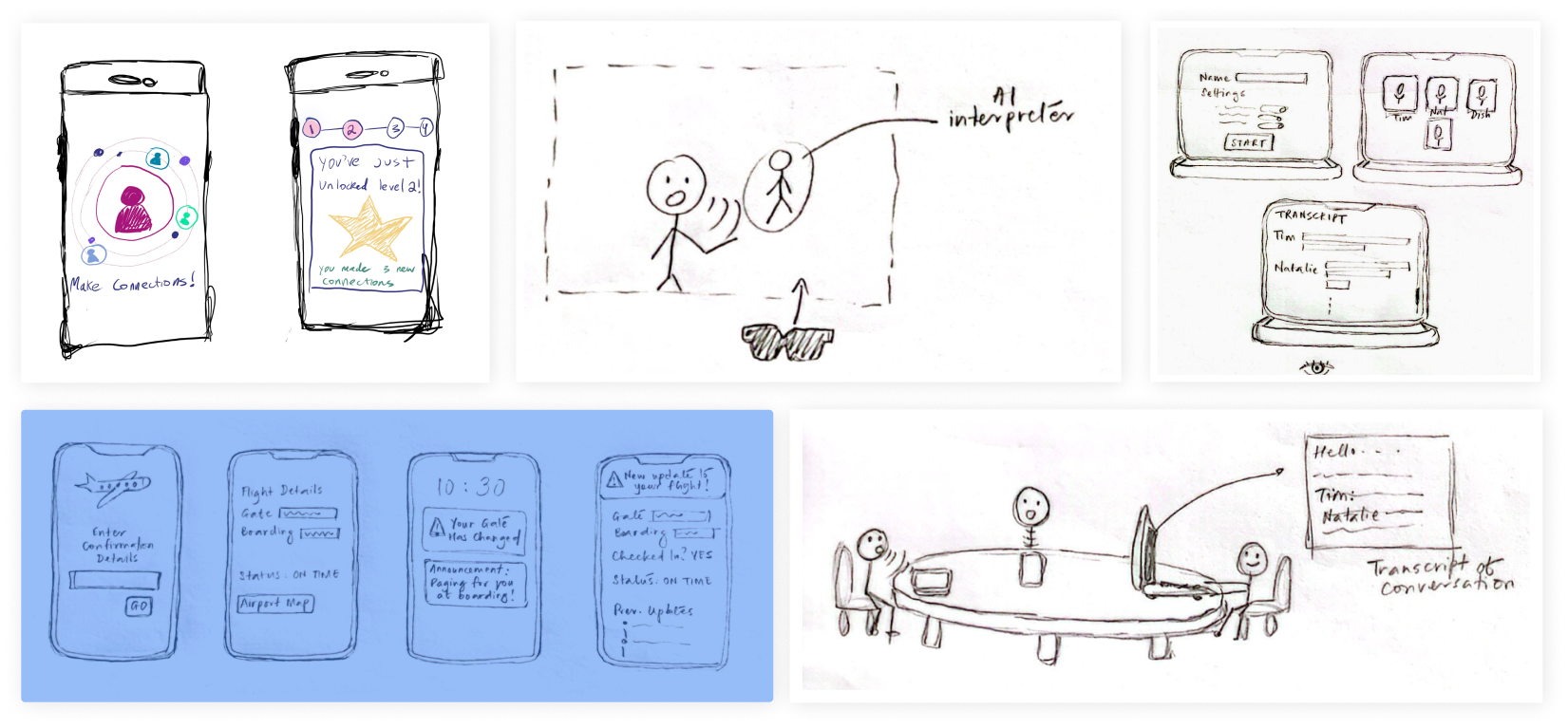
We brainstormed 100 ideas—both good and bad—which were then evaluated and refined into 5 strong themes. One focused on the public transit experience stood out
"An enjoyable travel experience is one where I don't have to worry too much about where to go next. I find that time can be wasted when plans are not made ahead of the trip"
Image of sketched designs
We revisited the recurring theme of insufficient audio accessibility in public transit.
Image of sketched concepts with highlighted one being the public transportation concept
Once the design concept was defined, we retraced ourselves back to our user group to ensure that their needs were being addressed.
Participatory Design Sessions – evolving our concept into designs via expert critiques
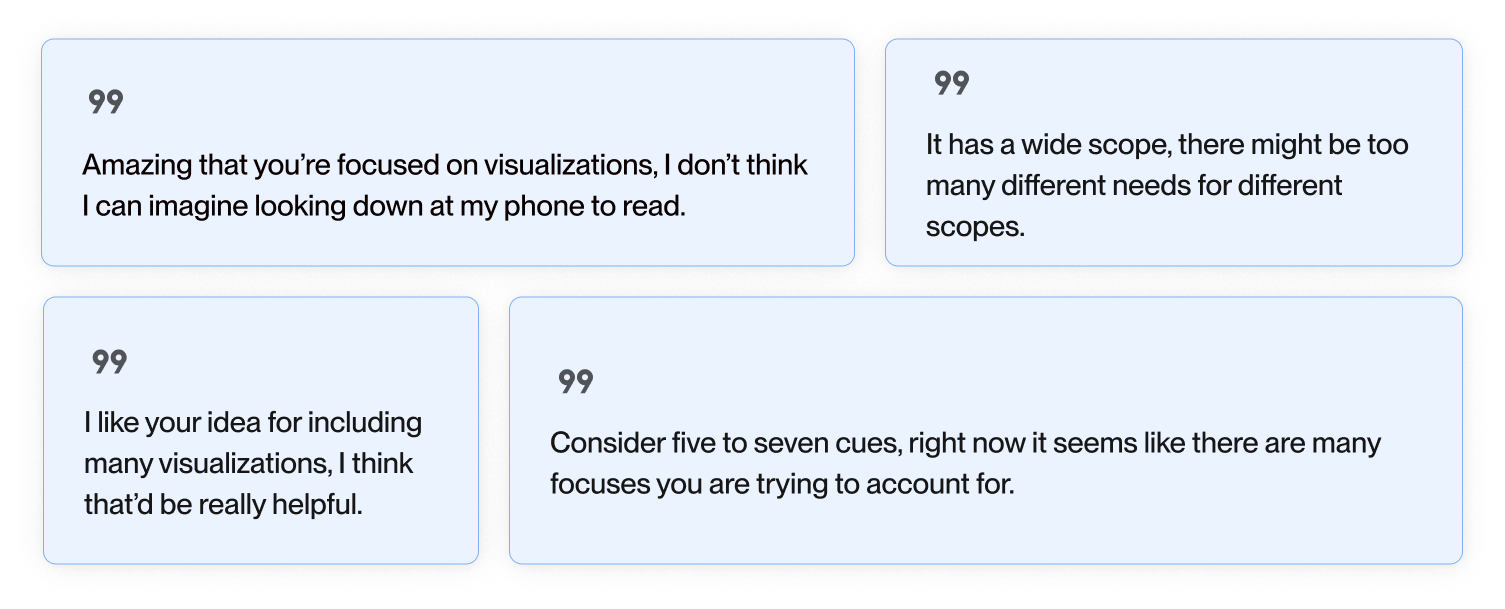
Recommendations focused on reducing text reliance, using visual symbols for alerts, and limiting cues to a small set of high-priority ones
Image of participant quotes from interviews, Participant 1: “Amazing that you’re focused on visualizations, I don’t think I can imagine looking down at my phone to read.” Participant 2:  “Consider five to seven cues, right now it seems like there are many focuses you are trying to account for.” Participant 3: “I like your idea for including many visualizations, I think that’d be really helpful.” Participant 4: “It has a wide scope, there might be too many different needs for different scopes.”
However, after detailing design concepts with other UX designers and researchers, I discovered that...
Designing an entirely new product was unnecessary. Most users already relied on Google Maps
Before prematurely designing mid-fidelity concepts of our feature, I emphasized that we conduct a comprehensive audit of Google Maps to ensure the feature could be introduced where users expect its use.
DESIGN DECISIONS
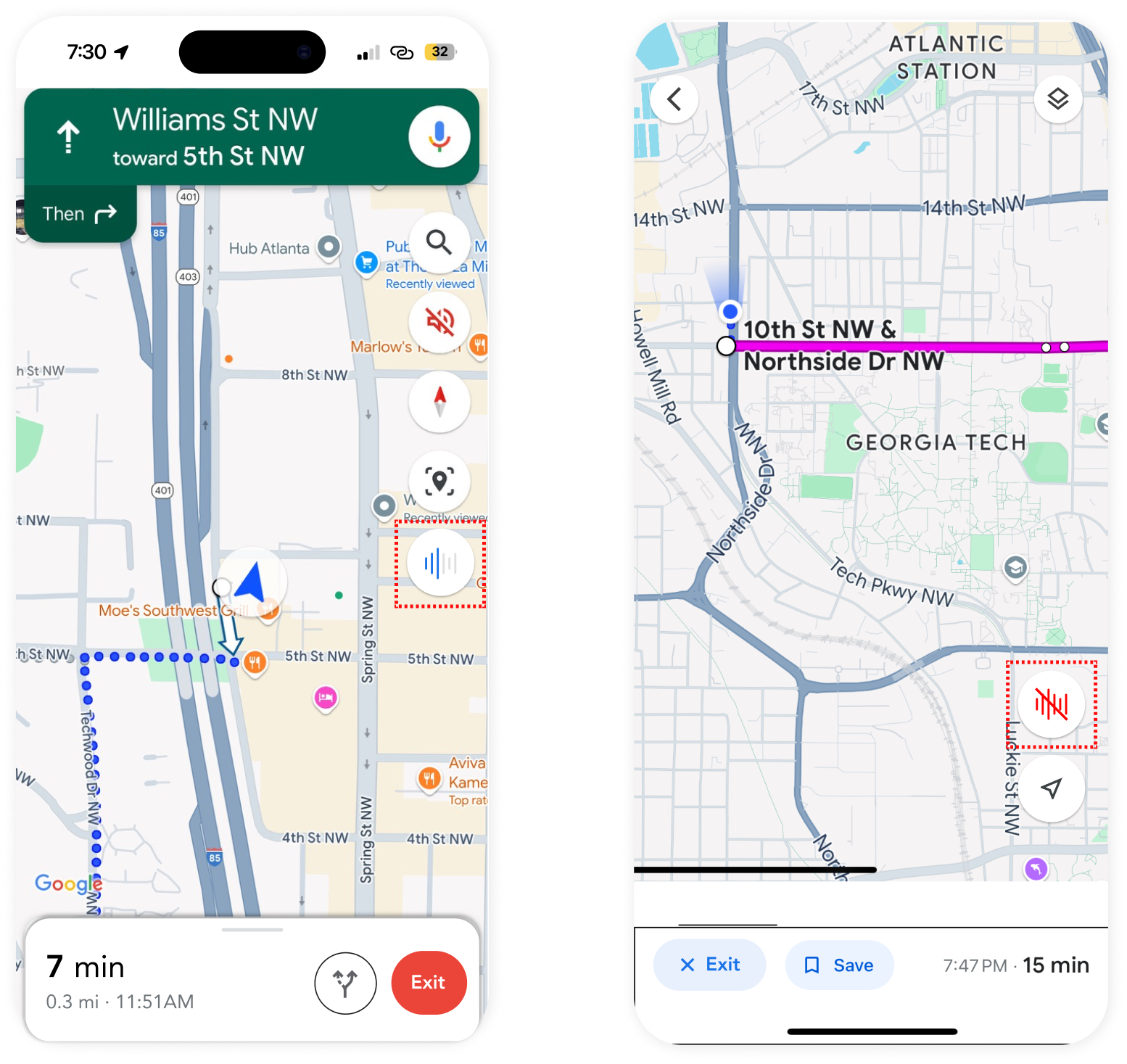
There were contextual nuances determining the optimal placement of our feature
A comprehensive audit of a transportation journey on Google Maps helped to identify events where the feature could be included. Here, the audio detection button's determinant location is based on the mode of transportation (walking versus public transit).
Image of interface iterations
This led to the conception of three key functions of our feature...
EVALUATION
There were minor inconsistencies, but overall the design reflected Google Maps standards
I focused on distinct criteria of assessment, including evaluating the visual design’s adherence to established design standards and assessing whether it met the expectations of the target user group.
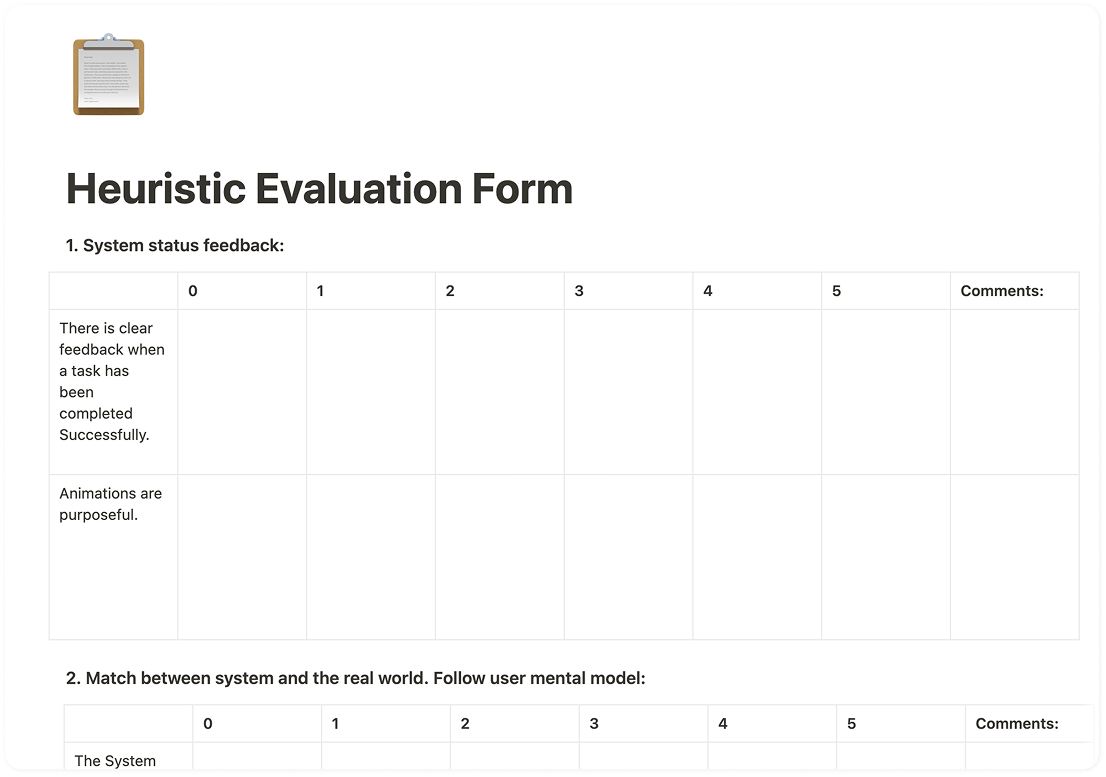
Image of heuristic evaluation forms, "We included 10 different criteria to which our system would be evaluated", "A high-level sub-criteria, giving us assessment of how successful our design was delivered, measured to design heuristics cited by Jakob Nielsen"
Below, are three design considerations that we addressed upon receiving feedback on our designs from users and experts.
1 – Relying solely on color to convey information is not accessible, especially for colorblind users
Color indicators were replaced with audio bars that increase with background noise, an affordance for how close a transportation vehicle is to arrival.
Image of interface iterations "Initial Design - Audio levels defined by colors had no semantic significance Not easily determined what color is associated with an audio level", "Final Design -  Improved definition of differences afforded by audio spectrum differences Easily legible appearance of audio spectrum button"
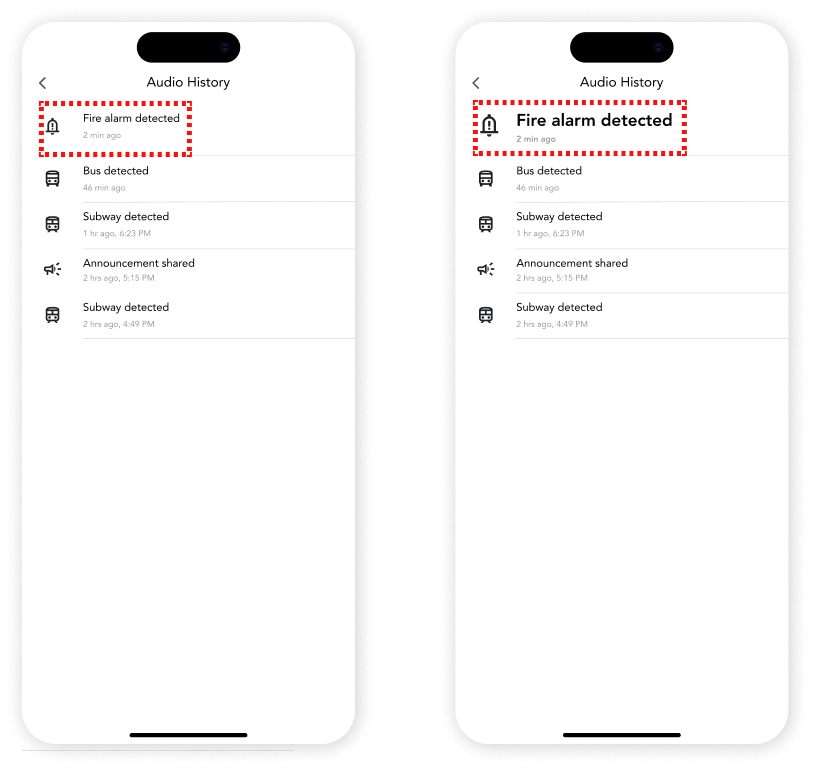
2 – The audio history feature was initially perceived as hidden, and participants expressed uncertainty about its necessity
Alerts were highlighted by bolding and increasing the size of text to emphasize the most recent event.
Image of interface iterations "Initial Design - Most recent audio cue did not have significance Experts from heuristic evaluation could not determine use case for this screen" "Final Design - Most recent history given bolded, larger appearance Gives significance to recent audio cue in history for recall"
The original flow let users view audio alert history, but alerts lacked prominence, and timestamps were unclear.
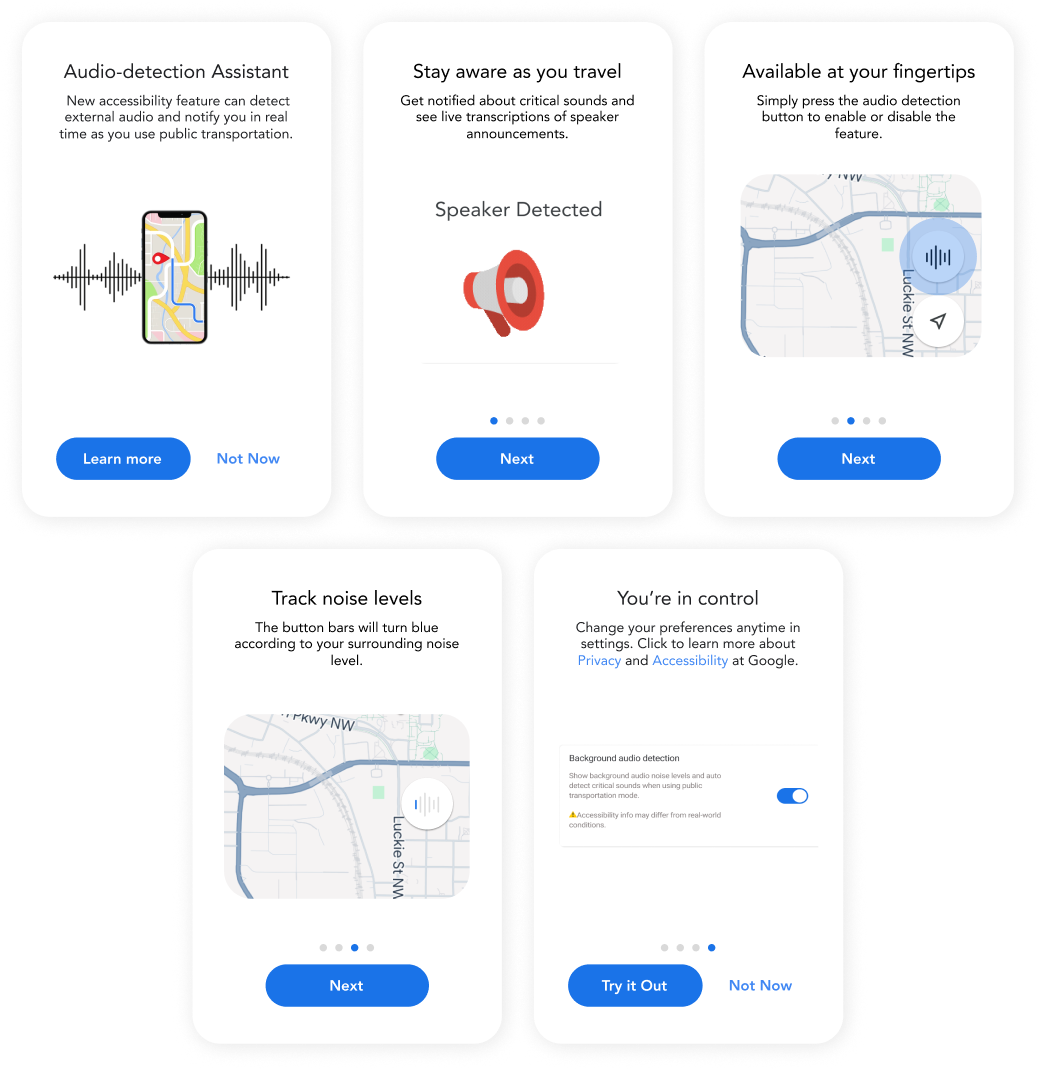
3 – New features lacked memorability, but what would it take to improve them?
While a reminder feature could highlight the functions, I proposed that it might increase cognitive load, resulting in more drawbacks than benefits.
Image of interface iterations "Design Considerations - Experts suggested incorporating reminders of onboarding features throughout the transportation journey. However, repeated reminders could increase cognitive load and potentially hinder the experience."
REFLECTION
Establishing strong relationships valuably shaped our prototype
We worked with several participants multiple times, which was rewarding as they could see how their feedback directly shaped further iterations.
Incorporating Surveys for Broader Feedback
While one-on-one sessions with a small group provided valuable insights, we recognize the need for broader data collection.